
About 30% of the Epic of Gilgamesh is still missing. The story has been read since 1872 and translated again and again, yet some of its scenes still break off mid-sentence. For anyone trying to understand AI ancient texts research, that gap is the right place to start, because the missing lines are probably not gone. Many of them sit in museum drawers, on small pieces of clay that nobody has connected to the right tablet yet.
Munich's Fragmentarium was built to make those connections. It didn't "decode" Gilgamesh, and it doesn't read the clay. It compares the signs that specialists have typed up from tens of thousands of fragments, then tells them where to look. Since 2018 that approach has produced more than 1,500 new matches, including 20 new pieces of Gilgamesh and a hymn to Babylon that hadn't been read for about two thousand years.
This post walks through how it works, what it found, and why the real breakthrough was making the text searchable in the first place.
Why the world's oldest epic is still full of holes
Babylonian scribes wrote by pressing a reed stylus into damp clay, leaving the wedge-shaped marks we call cuneiform. A clay tablet can survive for thousands of years. It just doesn't survive in one piece very often.
The best-known copies of Gilgamesh come from Nineveh, where the Assyrian king Ashurbanipal built up a huge library in the 7th century BCE. When the city was sacked in 612 BCE, the tablets fell, cracked and were buried in the rubble. Excavators dug them out by the thousand in the mid-1800s and shipped them to London. The British Museum's database now counts 30,943 "tablets" from that collection alone, and some are no bigger than a matchbox. Pieces of one original tablet can carry completely different museum numbers, depending on who dug them up and when.
Then there's the size of the field. Museums and universities hold as many as half a million cuneiform tablets, plus many more fragments, and only a small number of people can read them. A lot of that material has never been read closely. Even more has never been published.
Gilgamesh adds one more complication. It was copied for well over a thousand years, in different cities and different centuries. A broken piece could belong to any one of dozens of copies, each with its own spellings and small differences in wording.
How fragments were matched before: memory, paper and luck
In 1872 George Smith, a largely self-taught assistant at the British Museum, was working through tablets from Nineveh when he recognised a boat run aground on a mountain and birds sent out to find dry land. It was the flood episode of Gilgamesh. Smith spent the rest of his short life hunting for more of the poem, and died on an expedition to the Middle East in 1876, aged 36.
For the next 150 years the method stayed close to his. A specialist copied the signs from a fragment onto paper, compared them with everything they had read before, and hoped something clicked. A match depended on one person's memory, the notebooks they had seen and the drawer they happened to open. The Assyriologist Rykle Borger once wrote about the frustration of matching pieces "lying in drawers just a few meters away" from each other, unrecognised.
Cuneiform makes this harder than it sounds. "There are up to 25 ways to represent the same syllable," Enrique Jiménez, who leads the Munich project, has said. Scribes also spelled words the way they had been trained, with no fixed standard. Two copies of the same line can look quite different on the surface, which is exactly what defeats a simple text search.
Even so, scholars made about 5,000 joins this way. A join means proving that two pieces once belonged to the same tablet. Five thousand in roughly a century and a half works out to about 33 a year.
How the Fragmentarium actually works
The Fragmentarium is the database at the centre of the electronic Babylonian Library (eBL), a project Jiménez started at LMU Munich in April 2018. Most AI ancient texts headlines make it sound like one clever model. In practice it's a pipeline, and most of the steps are done by people.
Photograph the pieces. The team has photographed thousands of fragments together with the British Museum in London and the Iraq Museum in Baghdad.
Type up every sign. Specialists transliterate each fragment, writing every cuneiform sign in Latin letters so a computer can search it. They got through more than 16,000 fragments in the first two years and about 22,000 by early 2023.
Compare short runs of signs. The software breaks each text into short overlapping runs of up to three signs, known as n-grams, and compares them with every other fragment and with the edited texts in the eBL Corpus. A 2024 paper from the team tested several methods and found that this n-gram approach worked well, giving Assyriologists "a large speed-up". Jiménez has compared the idea to the way biologists line up DNA sequences that differ slightly.
Rank the candidates. Instead of 22,000 possibilities, a researcher gets a short list of likely matches.
Check by eye. An Assyriologist reads each candidate against the photos and decides. Only then does a match count as a join or an identification.
The comparison step is what takes the sting out of spelling variation. Two fragments don't have to be written identically. They only need to share enough short runs of signs to stand out from the background noise.
Each confirmed piece also improves the next search. A newly placed fragment adds text to the reconstructed edition, which gives the software more to match against, and one overlap often leads straight to another.
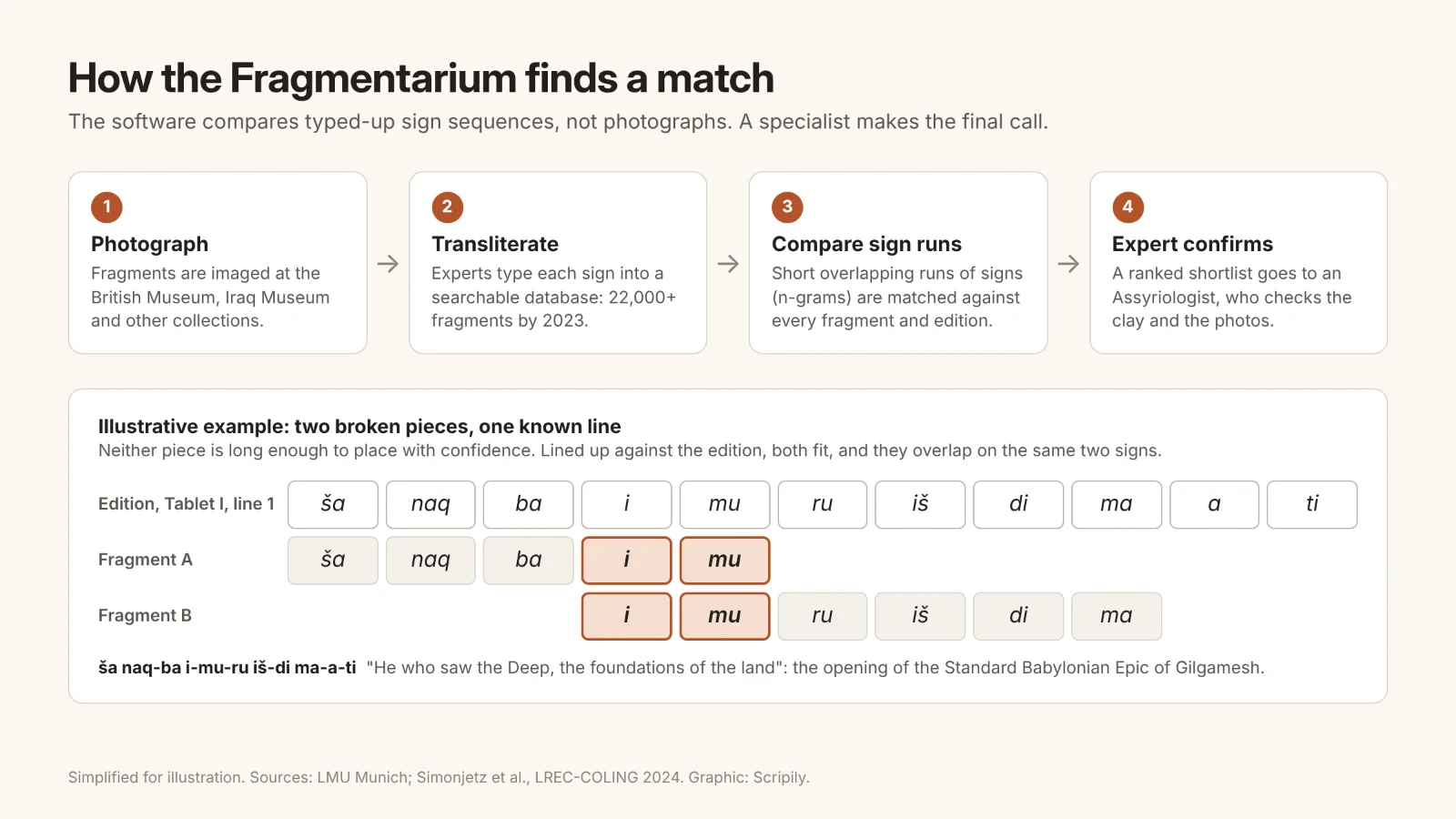
Two broken pieces line up against the opening line of Gilgamesh and overlap on the same signs. Simplified example. Credit: Graphic: Scripily.
Since February 2023 the Fragmentarium has been open to anyone at ebl.lmu.de. Before that, about 200 scholars had used it on request. "Everybody will be able to play around with the Fragmentarium," Jiménez said ahead of the launch. "There are thousands of fragments that have not yet been identified."
What AI ancient texts research has actually found
The headline number is the pace. Before 2018, about 150 years of scholarship had produced roughly 5,000 joins. In the six years after the Fragmentarium went to work, Jiménez's team added more than 1,500, plus several thousand identifications of pieces that belong to known texts but don't physically touch.
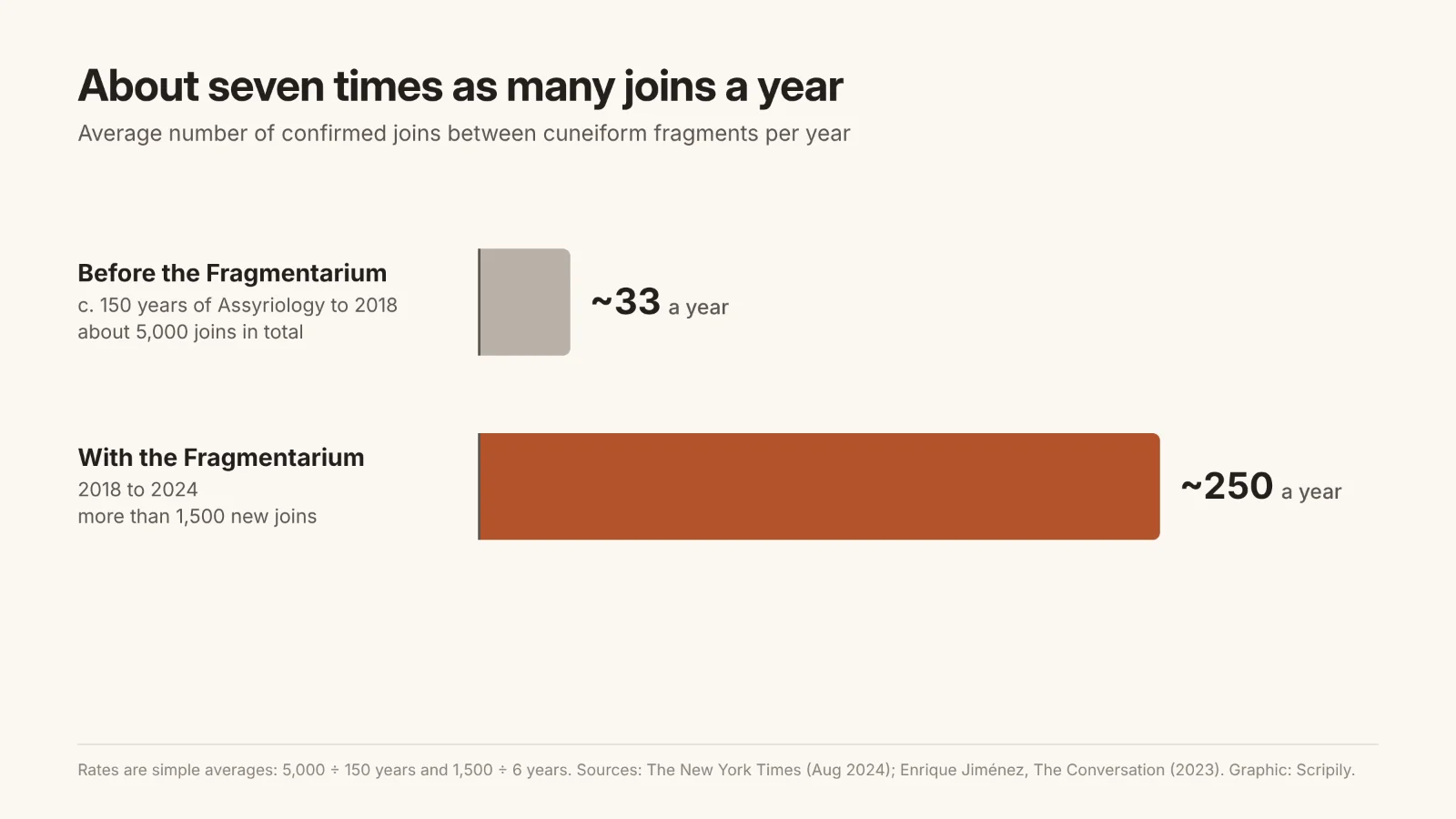
Average joins per year, before and after the Fragmentarium. Simple averages from published totals. Credit: Graphic: Scripily.
Twenty new pieces of Gilgamesh
Twenty of the newly placed fragments belong to Gilgamesh. Together they add detail to more than 100 lines of the epic. A few examples:
After killing Humbaba, the monster who guards the Cedar Forest, Gilgamesh and Enkidu travel to Nippur, the religious centre of Mesopotamia. "They went there hand in hand, in an attempt to appease Enlil, who was angered by their killing of Humbaba, his protege," Jiménez told The New York Times.
New lines show Enkidu trying to talk Gilgamesh out of killing Humbaba. Others preserve part of a prayer in which Gilgamesh's mother asks the sun god to touch Enkidu so he can lead her son through the forest, according to Yale's Benjamin R. Foster, who worked on the English translations.
In the flood story, Utnapishtim now says he "lavished" drink on the workers who built his boat. Foster reads guilt into that one word, because the men celebrating are about to drown.
Some of these finds already appear in recent translations by Sophus Helle (Yale University Press, 2021) and Andrew George (Penguin Classics, 2020). Helle compared translating a text that keeps growing to "painting a model who won't sit still."
In November 2022 the software also placed a fragment from the most recent known Gilgamesh tablet, dated to 130 BC. That copy was made well over a thousand years after the earliest versions, so people were still copying the poem in the last centuries of cuneiform writing.
A hymn nobody had read for 2,000 years
In January 2023 Jiménez mentioned a text he was working on with an Iraqi colleague: a hymn to the city of Babylon. "Previously, there were no known hymns to cities in Babylonian literature," he said. By then the team had found 15 new fragments of it. "Without the Fragmentarium, the reconstruction process would have taken 30, 40 years."
The full study came out in 2025 in the journal Iraq, by Anmar A. Fadhil of the University of Baghdad and Jiménez. It began with a tablet from the Sippar Library, and the platform turned up 30 more manuscripts of the same text. The hymn runs to about 250 lines and was probably composed around 1000 BCE. So many copies survive because schoolchildren copied it out as a writing exercise.
It's an unusual piece. It describes the city's buildings, the Euphrates bringing spring to the fields, and the people of Babylon, from their respect for foreigners to the roles of its priestesses. Surviving Mesopotamian literature rarely spends this long on nature. One passage reads:
The Euphrates is her river – established by wise lord Nudimmud – It quenches the lea, saturates the canebrake,
Translation: electronic Babylonian Library, via LMU Munich.
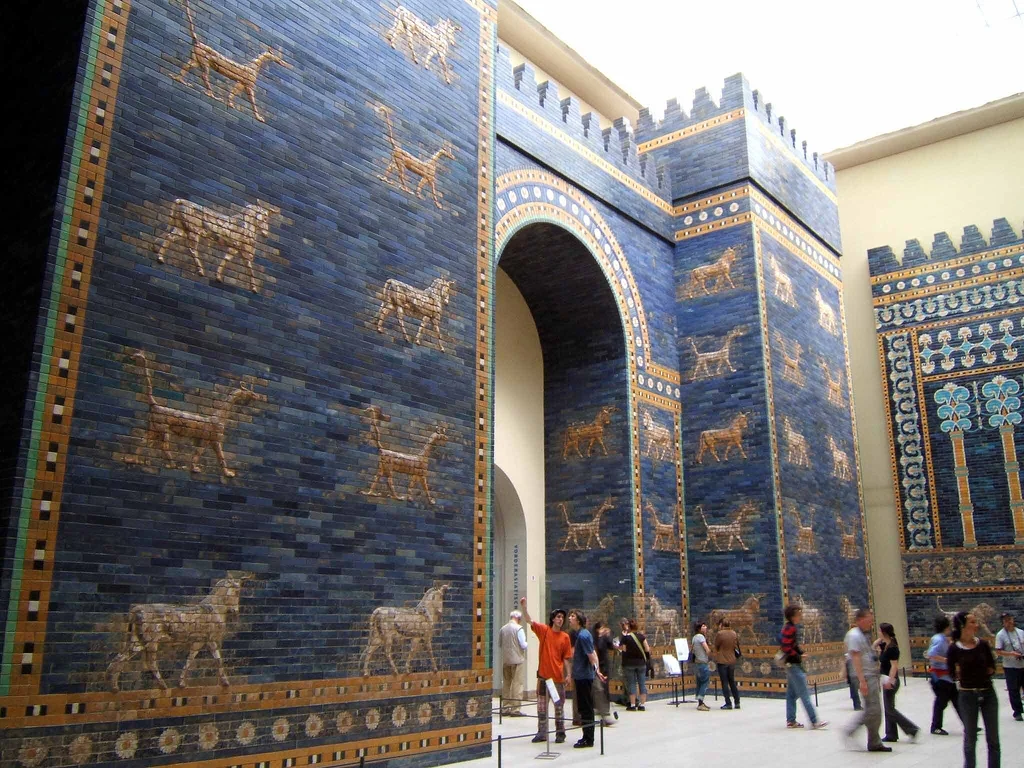
The Ishtar Gate of Babylon, rebuilt in Berlin. The newly read hymn praises the same city, centuries before the gate went up. Credit: Photo: Rictor Norton, CC BY 2.0, via Wikimedia Commons.
Why searchable text was the real breakthrough
It's tempting to give the algorithm all the credit, and most AI ancient texts coverage does. But comparing short runs of characters is an old idea. Search engines and DNA tools have used versions of it for decades. What Munich had, and nobody had before, was enough searchable text to run it on.
For most of the field's history, transliterations lived in notebooks, journal articles and private files. George Smith's papers, and the transliteration collections of many scholars after him, never became a shared resource anyone could query. A fragment that hasn't been typed up can't be compared with anything. So the slow, unglamorous work had to come first: tens of thousands of fragments, transliterated sign by sign, in one place and one consistent format. Once that existed, finding matches became a search problem.
The team's newest work shows how hard the reading step still is. A June 2026 preprint from LMU ran an automatic sign detector across 87,668 fragment photos in the eBL and produced nearly 2.9 million sign detections. That's real scale. But when the machine's readings were checked against experts' transliterations, the average match score was 0.23, where 1.0 would mean full agreement. The authors also note that on damaged signs the model often makes "confident but incorrect predictions". It's a useful first pass. It isn't a replacement for a trained reader.
What AI ancient texts tools don't do
It doesn't translate. The matching runs on sign sequences, and the meaning still comes from scholars. Jiménez has noted that Akkadian and Sumerian are still underrepresented in large language models.
It doesn't decide. Every join is checked by a specialist against the photos and, where possible, the clay itself.
It doesn't solve every puzzle. One of the new Gilgamesh lines has Utnapishtim asking, "Did they ever, Gilgamesh, build a palace for a fool?" Foster's verdict: "We don't have any idea what he's talking about." The answer may be sitting on a fragment nobody has typed up yet.
What this means if you work with old documents
The lessons from this AI ancient texts project reach well beyond clay. Parish registers, ships' logs, family letters and old company ledgers have the same problem on a smaller scale: the information exists, but it's locked in handwriting nobody can search.
Transcribe before you search. A scan is a picture. Until the words become text, no tool can find a name, a date or a matching passage across a collection. (More on this in our guides to transcribing old records.)
Keep the image next to the text. The eBL links each transliteration to its photos, so anyone can check a reading. Do the same with your own transcriptions.
Plan for spelling variation. Babylonian scribes spelled words many ways, and so did the parish clerk who wrote "Smyth" one year and "Smith" the next. Search with variants in mind.
Let software shortlist and people decide. The Fragmentarium narrows thousands of possibilities to a handful. A person still makes the call.
Don't throw away small fragments. A torn corner or a scrap with five legible lines can be the piece that completes something larger.
Why Scripily fits this kind of work
The Fragmentarium's biggest lesson is simple: you can't search what you haven't transcribed. Scripily handles that first step, the one every AI ancient texts project depends on, for handwritten and historical documents. It reads centuries-old handwriting, faded ink and archaic typefaces, restores damaged pages, and turns scans and PDFs into searchable text you can export, with tables and fields pulled out as structured data. It works across many languages and offers shared workspaces and an API for bigger collections. If you're an archivist, a genealogist or a researcher with a box of letters, Scripily gets your documents to the point where the real searching can begin.
Frequently asked questions
What is the Fragmentarium?
A searchable database of transliterated cuneiform fragments, built by the electronic Babylonian Library project at LMU Munich since 2018. Software compares sign sequences across the collection to suggest which pieces belong together.
Did AI translate the Epic of Gilgamesh?
No. The software suggests matches between fragments. Assyriologists confirm the joins and do the translating.
Will AI ancient texts tools replace Assyriologists?
Not on current evidence. The Munich team describes its tools as a way to speed up specialists, and every match still needs an expert to read and confirm it.
How much of Gilgamesh is still missing?
About 30%, according to a 2024 report in The New York Times. LMU puts it the other way round: scholars have brought about two-thirds of the text into readable shape since it was rediscovered in the 19th century.
Can anyone use the Fragmentarium?
Yes. It has been open to the public since February 2023 at ebl.lmu.de.


